
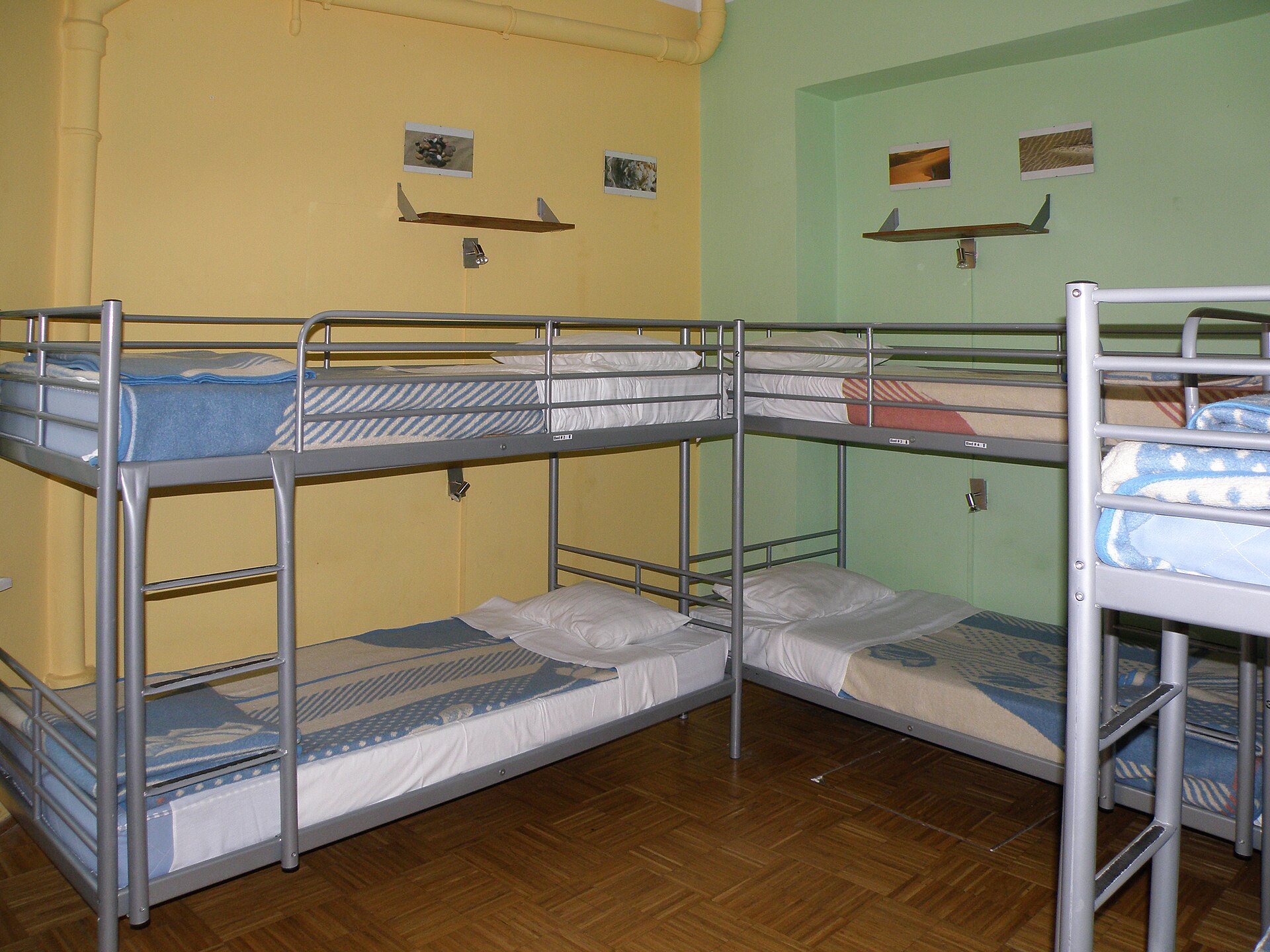
Nobody warns you about this part. You book a bed in a six-person dorm, you arrive, and the receptionist hands you a key card and says “bed four.” Bed four is a top bunk wedged against the door, under a vent that rattles all night. You lie there at 2 a.m. listening to a stranger snore and wonder whether the money you saved was worth it. It was — but only if you learn to pick your bed. After a lot of nights at Red Star watching guests figure this out the hard way, here is what we have learned.
Ask for the bed, don’t just take it
Most travelers assume bed assignments are fixed. They rarely are. When you check in, ask which beds are free and whether you can choose. On a quiet night the staff will often walk you to the dorm and let you pick. At Red Star we do this as a matter of course, because a guest who slept well is a guest who is pleasant at breakfast, and that makes everyone’s day easier.
If you book online, look for hostels that let you select a bottom or top bunk at the booking stage. Some charge a little more for bottom bunks or for beds with privacy curtains, usually a small premium over the base dorm rate. Whether that is worth it depends on how you sleep, but if you know you struggle with noise or you are carrying an injury, it is money well spent.
And if you arrive and the assigned bed is genuinely bad — next to a broken window, under a leaking pipe, above someone who has clearly been sick — say so politely. Staff can usually move you. They cannot fix what they do not know about.
Position: the map of a dorm room
Every dorm has good beds and bad beds, and the pattern is remarkably consistent from one hostel to the next. Think of the room as a map.
- Away from the door: the bed nearest the door takes every arrival, every departure and every bathroom trip. Light spills in each time it opens. Pick the far corner if you can.
- Away from the bathroom: if the dorm has an en-suite, the bed beside it hears every flush and every shower at 6 a.m. The extractor fan is often louder than the people.
- Near a window, but not under it: fresh air matters more than you think in a room of six sleeping bodies. But a bed directly beneath a window gets street noise, early light and, in winter, a cold draught down your neck.
- Away from the light switch: people fumble for it in the dark, and they turn it on without thinking. The bed next to the switch gets a face full of light at every hour.
- Near a power socket: increasingly common in newer hostels, but not universal. A bed with its own socket means your phone charges beside you instead of on the floor by the door.
Corners are the prize. A bottom bunk in a corner has two walls, one neighbour instead of three, and a natural sense of enclosure that helps you switch off. If you cannot get a corner, the next best thing is any bed with a wall on one side.
Top or bottom: it is not just about climbing
The old rule says bottom bunks are better, and for most people they are. You have somewhere to sit, your bag is within reach, and you do not need to negotiate a ladder in the dark after a few drinks. Bottom bunks are also cooler in summer, since warm air rises.
But top bunks have real advantages that get overlooked. Nobody sits on your bed by accident. Nobody uses your mattress as a shelf for their wet towel. You are above the eye line of the room, which brings a surprising amount of privacy, and in a dorm with a curtainless bottom bunk facing the door, the top bunk can actually be the darker, quieter option. Light sleepers who wake at movement often do better up top, because the bottom bunk shakes every time the person above rolls over, while the reverse is far less true.
The deciding factors are your knees, your bladder and the ladder. If you get up in the night, take the bottom. If the ladder is a set of welded rungs with no handrail, take the bottom. If neither applies and the room is busy, the top can be the better sleep.
Noise: what you can and cannot control
Here is the honest truth: you cannot make a dorm silent. Somebody will snore. Somebody will come in late. A zip will be zipped. Your job is not to eliminate noise but to make yourself indifferent to it.
Earplugs are the single biggest upgrade to dorm sleep, and the cheap foam ones from a pharmacy work as well as anything. Roll them tight, hold them in for a few seconds, and they block far more than you expect. Pair them with an eye mask and you have removed the two things most likely to wake you.
Then there is the social side. Dorm noise drops sharply in rooms where people have said hello to each other. Once you have exchanged names, the person coming in at midnight tends to use their phone torch instead of the ceiling light. So introduce yourself. It costs nothing and it is the best noise-reduction tool there is.
Read the room before you unpack
Spend thirty seconds looking at your dorm before you claim a bed. Is there a pile of party gear on one bunk and a row of empty bottles on the windowsill? That is a late-night room. Is there a hiking pole leaning on the wall and a pair of boots drying by the radiator? That room will be up at six. Neither is wrong, but you want to match your own rhythm to it.
Look for a working locker under or beside your bed. Check the mattress for stains or a musty smell — that is not fussiness, it is basic hygiene. Test the bed frame with a hand: a wobble now means a squeak all night. If a curtain is fitted, check it actually closes. A few seconds of inspection saves hours of regret.
The bed is only half the story
Choosing well matters, but the deeper skill is accepting that dorm sleep is different sleep. It is lighter, more interrupted, and it comes with a soundtrack. Once you stop fighting that and start working with it — the right corner, the right bunk, plugs in, mask on, a nod to your neighbours — you will find you sleep far better than the price would suggest. Most nights at Red Star, the room goes quiet by midnight and stays that way until the gulls start up. That is not luck. It is a room full of people who each picked their bed with a bit of thought.